Insurance Credentialing for Mental Health Providers: Complete 2026 Guide

If you run a therapy practice, group practice, or outpatient behavioral health clinic in California, insurance credentialing is not “admin work.” It is revenue access.

When credentialing is done right, you can accept the patients who actually want to see you, bill cleanly, and avoid months of claims getting denied because a provider was never correctly linked to the group, location, or payer system. When it is done wrong, it shows up as delayed cash flow, lost sessions, and a front desk stuck explaining why a patient is suddenly out of network.

This guide is written for practice owners and operators who need a clear plan, not a textbook.

What are Mental Health Credentialing Services?

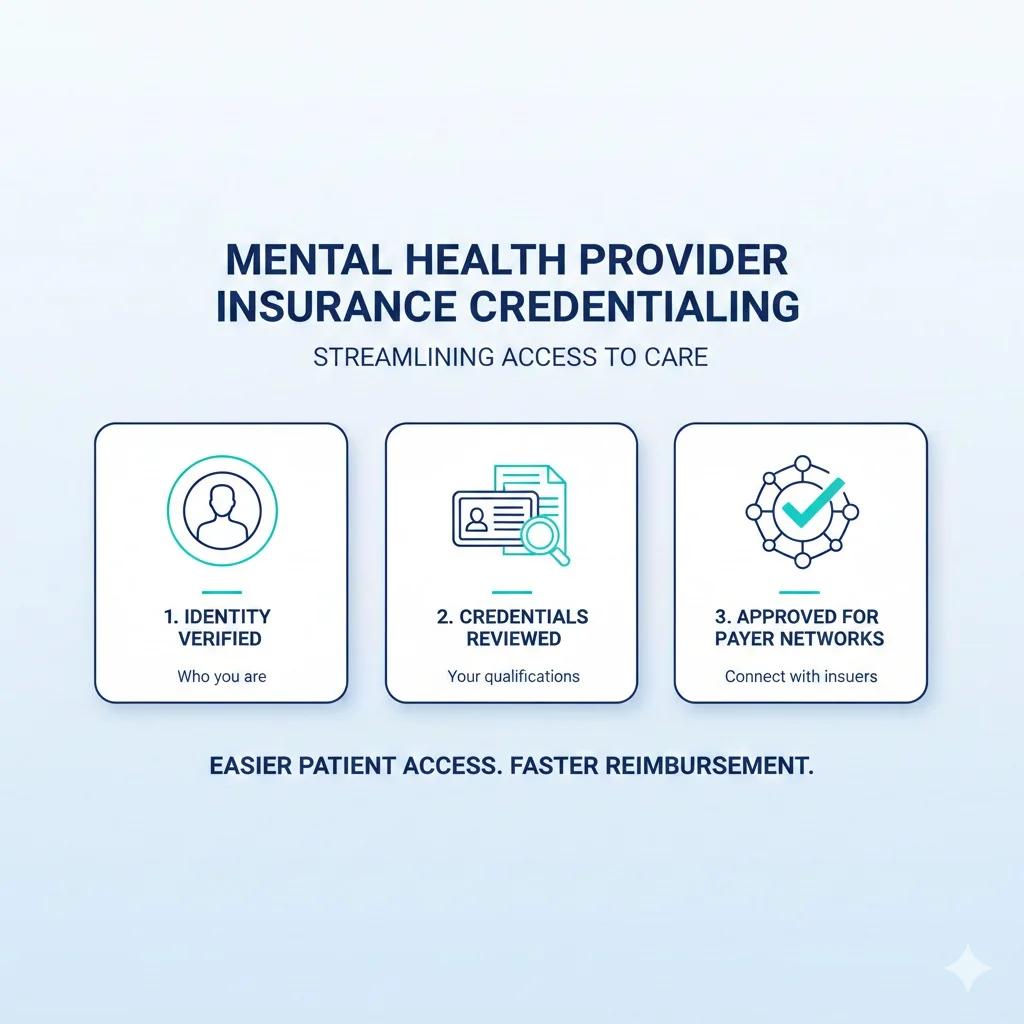
Mental health credentialing services manage the administrative process of vetting a provider’s qualifications (education, license, malpractice history) with insurance companies. In 2025, this process involves two distinct phases: Credentialing (verification) and Contracting (rate negotiation).

  • Time to Complete: 90–180 days on average in California.
  • Key Portal: PAVE (for Medi-Cal) and CAQH (for private payers like Aetna/Blue Shield).
  • Why Use a Service? To prevent revenue delays. A single error on an application can restart the 3-6 month clock, halting your ability to bill.

Table of Contents

What “credentialing” actually means for mental health practices

Mental Health Providers Insurance Credentialing Credentialing is the payer’s process of verifying a provider and approving them to participate in a network. Contracting is the agreement and rates. Enrollment is the administrative setup that allows claims to be accepted and paid. These steps overlap, and that is exactly why credentialing feels messy in real life. For mental health providers, credentialing typically includes:
  • Verifying the clinician’s license and education • Confirming practice locations, tax structure, and billing identifiers • Ensuring CAQH information is complete and attested • Submitting payer specific applications • Confirming the provider is loaded correctly for claims and eligibility • Linking the provider to the group, location, and billing NPI correctly
CAQH ProView is a core hub many payers use to access provider data. It is free for providers, but it has to be kept accurate and re-attested.

Who this guide is for

This guide applies to small and mid sized mental health organizations in California, including:
  • Solo therapy practices • Group practices with multiple clinicians • Outpatient behavioral health clinics • Practices adding psychiatry, therapy, or testing services • New practices that want to accept insurance, including Medi Cal pathways

Why credentialing matters to your revenue

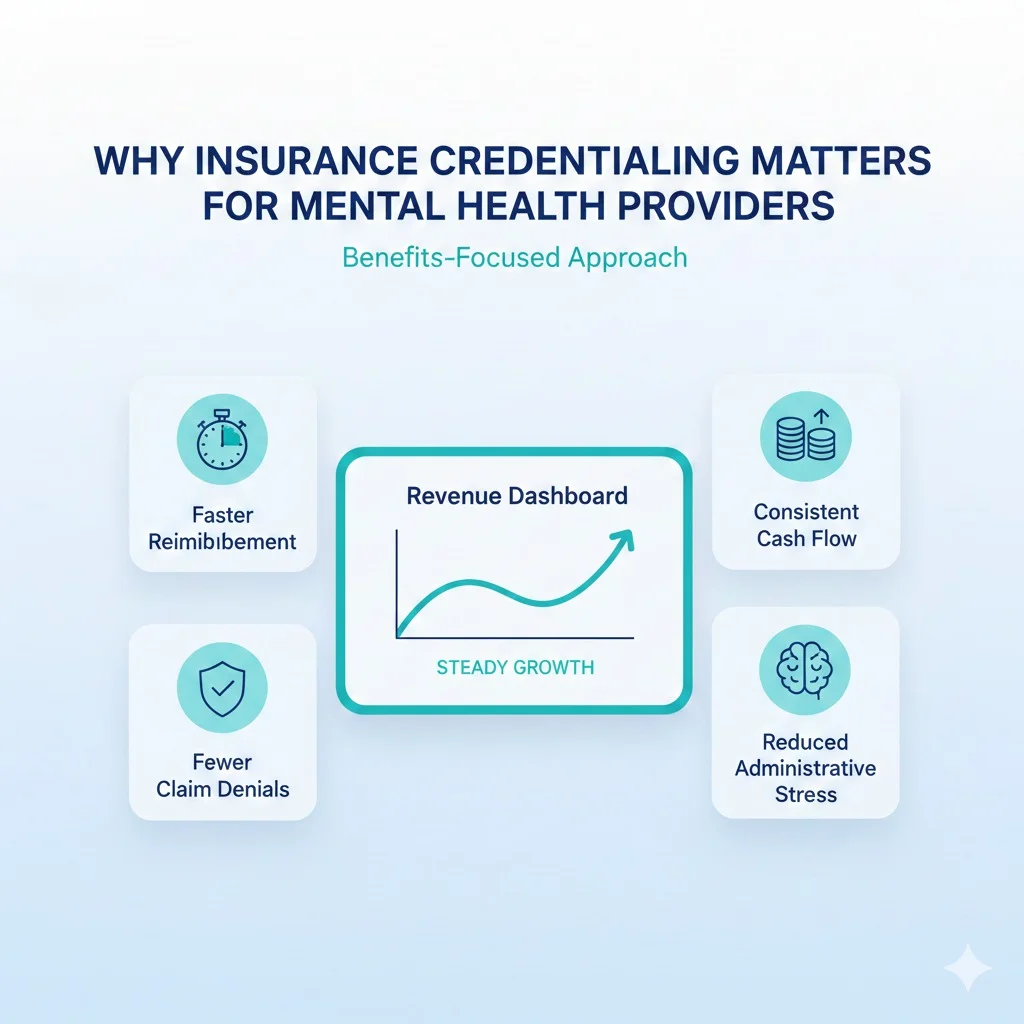
Insurance Credentialing Matters for Mental Health Providers Credentialing impacts revenue in very direct ways:
1. You cannot bill what you are not enrolled to bill
If a provider is not properly enrolled, claims can be rejected even if your notes are perfect.
2. Incorrect provider setup creates avoidable denials
Common denial patterns include: provider not on file, provider not eligible at location, taxonomy mismatch, group linkage errors, and rendering versus billing provider misalignment.
3. Credentialing delays create “invisible” financial losses
If you are seeing patients before approvals are active, you are often choosing between three painful options:
  • Hold claims and hope your timely filing window is safe
  • Bill out of network and risk patient dissatisfaction
  • Write off sessions if retro eligibility fails
This is why practice owners who want stability treat credentialing as a launch plan, not an afterthought.

California specific credentialing paths you should know

California adds complexity because many mental health patients are covered under Medi-Cal programs, managed care plans, and county based specialty mental health structures.
Medi-Cal credentialing and enrollment basics
To participate in Medi-Cal, providers often work through California DHCS enrollment systems and requirements. DHCS promotes Provider Application and Validation for Enrollment, commonly called PAVE, to submit and manage Medi-Cal enrollment activity. Depending on your service type and setting, there may be additional requirements for specialty mental health services or county programs. Provider enrollment processes for specialty mental health and Drug Medi-Cal have their own pathways and guidance in California. Important practical note: many practices in California end up with a blended strategy Commercial networks for broad access, plus Medi Cal related contracting where it fits your clinical model and staffing.

Requirements checklist for mental health provider credentialing

Below is the information most payers will require. Having this ready upfront is what separates a smooth credentialing cycle from a 5 month headache.
Provider identifiers
  • NPI for each clinician, and NPI for the organization if billing as a group NPI applications are handled through NPPES.
  • Tax ID, usually EIN for the entity
  • Taxonomy codes aligned to your services
  • Practice addresses and service locations that match what you will bill
Clinical and compliance documents
  • Active California license and license history
  • Education and training history
  • Work history
  • Malpractice coverage
  • W9
  • Government photo ID, where requested
  • Disclosure and attestation documents, where requested
CAQH profile
Many payers rely on CAQH ProView to verify and pull your data. CAQH’s provider guide explains how providers enter, authorize, attest, and maintain their profile.

Typical timelines in 2026

Timelines vary by payer and by how clean your initial submission is. In the real world, the biggest delay drivers are missing documents, inconsistent addresses, incomplete work history, and slow responses to payer requests. Timeline table for a typical California mental health practice
Stage What happens Typical timing
Setup and document prep NPI, entity info, malpractice, W9, locations, rosters 1 to 3 weeks
CAQH build and attestation Profile completion, uploads, attestation, corrections Often a few days to 2 weeks depending on responsiveness
Commercial payer credentialing Payer review, verification, committee approval, provider loading Commonly 60 to 120 days for many plans when everything is clean
Medicare enrollment if applicable PECOS enrollment, verification, application processing Processing benchmarks vary by MAC and application type
Medi Cal enrollment and setup DHCS enrollment workflows, plan specific setup where relevant Varies widely by provider type and program
If you are opening a practice or adding multiple clinicians, assume it will take longer than you want. Build your launch plan around that reality.

What credentialing costs, and what it really “costs” if you delay it

Hard costs you might see
  • Credentialing service fees if you outsource
  • CAQH is typically free for providers
  • Some payers may require additional documentation or signatures that create admin time costs
  • Insurance related costs such as malpractice coverage depend on your provider type and carrier
The bigger cost is usually opportunity cost Ask yourself:
  • How many new patients are you turning away because you are not in network yet
  • How many sessions are being delayed in billing
  • How many claims are at risk due to timely filing windows
  • How much staff time is being spent on phone calls and portal back and forth
For many practices, credentialing is a growth lever because it turns patient demand into collectible revenue.

The most common credentialing challenges for mental health providers

Mental Health Providers Challenges and control points
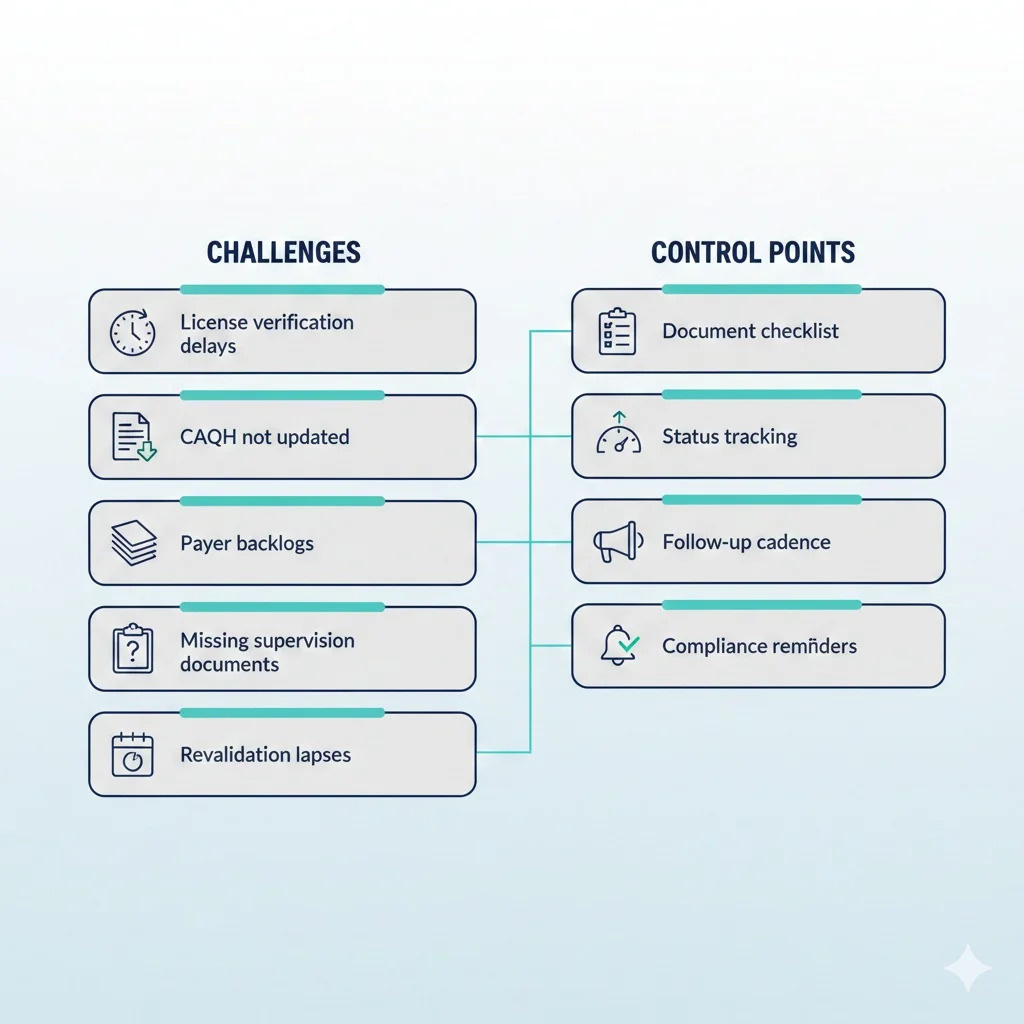
Incorrect group and location linking
A provider can be approved but not billable if they are not linked correctly to the group NPI, location, or taxonomy in the payer system.
Rendering versus billing confusion
Claims fail when the payer expects a different rendering provider setup, especially in group practices.
CAQH inconsistencies
Small mismatches in addresses, employment dates, or license details can trigger repeated payer requests. The CAQH process requires accurate entry, authorization, attestation, and ongoing maintenance.
Medi-Cal pathway complexity in California
Medi-Cal enrollment and specialty programs can require additional enrollment steps and program specific compliance. DHCS PAVE is a key portal for Medi-Cal provider enrollment activity. 
Slow follow up kills timelines
Credentialing is not submit and forget. Weekly follow up is often what prevents an application from sitting untouched for 3 weeks.

Step by step process that actually works

Insurance Credentialing for Mental Health Providers process
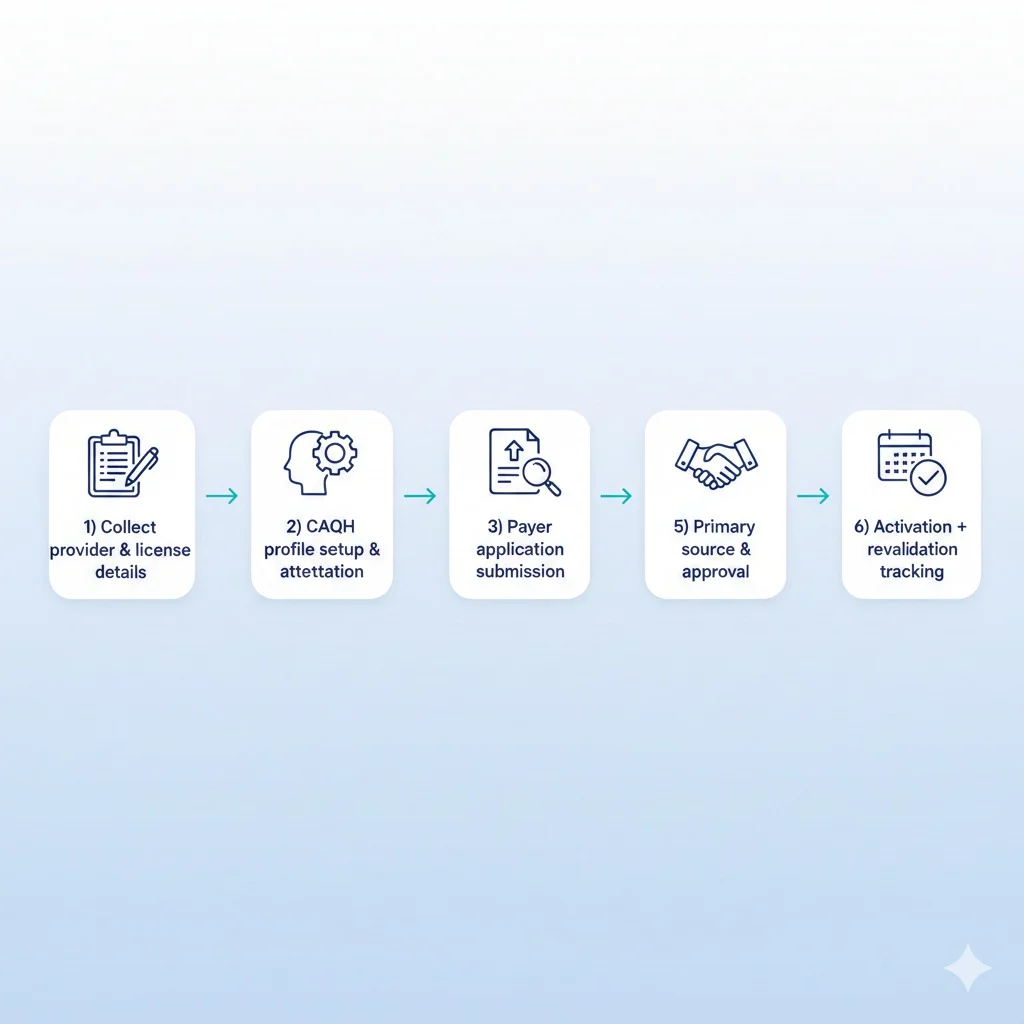
Step 1: Build your credentialing map
List every payer you want to accept, and decide whether you are credentialing:
  • Individual clinicians only
  • A group entity with multiple clinicians
  • Multiple locations
  • Multiple service lines, therapy, psychiatry, testing
Step 2: Lock down identifiers and structure
NPI applications are handled through NPPES.
Step 3: Complete CAQH the right way
  • Enter complete work history and education
  • Upload licenses, malpractice, and supporting documents
  • Attest
  • Set reminders for re-attestation
Step 4: Submit payer applications with clean attachments
Each payer has slightly different requirements. The goal is consistency:
  • Same address formatting everywhere
  • Same taxonomy usage across CAQH and payer portals
  • Clear W9 and entity documents
  • Correct provider roster data for group practices
Step 5: Follow up weekly until approval and loading are confirmed
Approval is not the finish line. You want confirmation of:
  • Effective date
  • Network status
  • Correct billing addresses 
  • Correct rendering provider setup
  • Claims submission pathway
Step 6: Do a readiness check before you start billing
Before you see your first in network patient, confirm:
  • Eligibility checks match the payer
  • Your clearinghouse or claim submission method is set
  • Your EHR billing settings match payer requirements
  • You know what goes on the claim, including rendering and billing identifiers

Frequently Asked Questions

How long does mental health credentialing take in California?

Many commercial credentialing cycles commonly land in the 60 to 120 day range when the application is complete and follow up is consistent, though timelines vary by payer and complexity. Medi-Cal related enrollment timelines vary widely by program and provider type.

What is CAQH, and do I need it?

CAQH ProView is a centralized provider data system used by many health plans. You enter your information, authorize access, attest, and keep it updated. Many payers rely on it to process credentialing faster and with fewer repeated document requests.

Do I need an NPI before I start credentialing?

Yes. Most credentialing and enrollment workflows require your NPI before the payer will process your application. NPI applications are submitted through NPPES.

Can I see patients before I am credentialed?

You can, but you should decide intentionally how you will bill and communicate financial responsibility. Many practices choose private pay until approvals are active, or they hold claims only when they have clear guidance on timely filing and effective dates. This is a business risk decision, not just an admin decision.

What is the difference between credentialing and contracting?

Credentialing verifies you. Contracting sets the agreement and reimbursement terms. In daily operations, they often move together, but you can be credentialed and still not properly loaded for claims if enrollment steps are incomplete.

How does Medi-Cal credentialing work for mental health providers in California?

Medi-Cal enrollment often involves DHCS provider enrollment workflows, and depending on your setting, you may also navigate specialty mental health or county structures. DHCS provides enrollment resources and the PAVE portal is a key system used to submit and manage enrollment activity.

We are a group practice. What is the biggest credentialing mistake to avoid?

Not aligning group and individual setup across every payer. The most common failures are incorrect linkage between the clinician, the group, and the service location, plus mismatched taxonomy and addresses.

How Claim N Billing supports mental health credentialing services in California

At Claim N Billing, we treat credentialing like the foundation of your revenue cycle, because it is.

Our credentialing support is designed for busy practice owners who do not have time to chase portals, fix mismatched records, and wonder why claims keep rejecting. We help you get set up cleanly, track every submission, and push applications forward with consistent follow up so you can start billing with confidence.

You can learn more about Claim N Billing and our credentialing focus on our site.

What you can expect when you work with us
  • A clear credentialing plan based on your payer goals and practice structure
  • Clean setup for providers, groups, and locations before submission
  • CAQH build support and ongoing maintenance guidance
  • Payer application submission and tracking
  • Weekly follow up and status updates
  • A practical go live checklist so you are not guessing when to start billing