
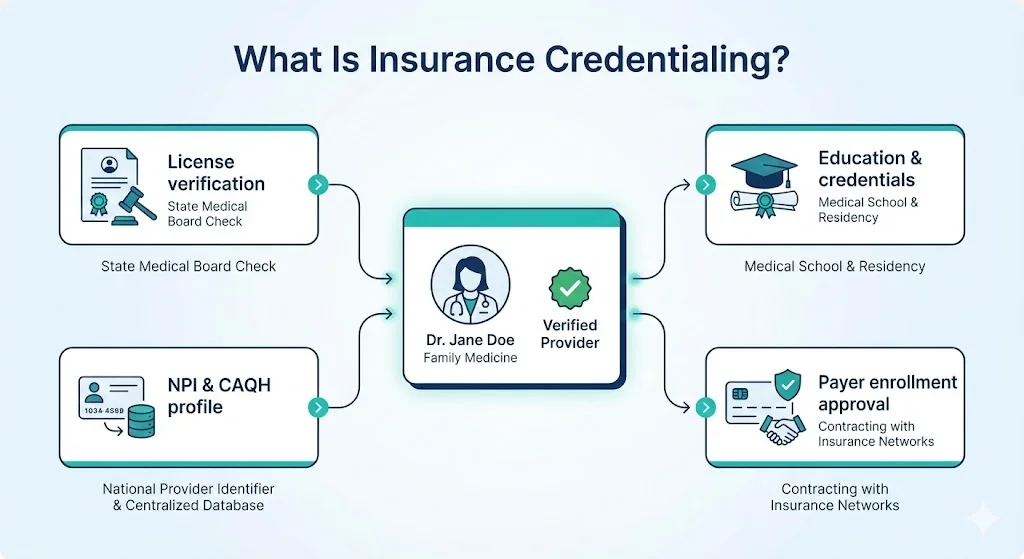
 At its core, insurance credentialing is a process by which payers verify that providers meet specific standards before approving reimbursement. It’s a thorough check of credentials degrees, board certifications, malpractice history, and more – to protect patients and maintain quality. For instance, an office of a family physician in Texas may need to verify the physician’s NPI (National Provider Identifier) and submit the information via CAQH. This central database allows the sharing of information with multiple insurance companies.
Credentialing is directly linked to compliance with federal regulations issued by the Centre’s for Medicare & Medicaid Services (CMS). If you fail to follow the rules, you may be subject to fines or audits. If you do it right and your Practice will gain access to larger patient pools, which boosts both your image and bottom line. Imagine receiving a badge that reads, “We’re vetted and ready to serve.”
Providers, such as physicians, nurse practitioners, and therapists, are all subject to this. For group practices, it extends to the entire facility, ensuring that everyone is aligned with the payer’s contract. The U.S. healthcare system, where private insurers are the dominant force alongside government programs, being accredited allows you to be open to a variety of reimbursements.
At its core, insurance credentialing is a process by which payers verify that providers meet specific standards before approving reimbursement. It’s a thorough check of credentials degrees, board certifications, malpractice history, and more – to protect patients and maintain quality. For instance, an office of a family physician in Texas may need to verify the physician’s NPI (National Provider Identifier) and submit the information via CAQH. This central database allows the sharing of information with multiple insurance companies.
Credentialing is directly linked to compliance with federal regulations issued by the Centre’s for Medicare & Medicaid Services (CMS). If you fail to follow the rules, you may be subject to fines or audits. If you do it right and your Practice will gain access to larger patient pools, which boosts both your image and bottom line. Imagine receiving a badge that reads, “We’re vetted and ready to serve.”
Providers, such as physicians, nurse practitioners, and therapists, are all subject to this. For group practices, it extends to the entire facility, ensuring that everyone is aligned with the payer’s contract. The U.S. healthcare system, where private insurers are the dominant force alongside government programs, being accredited allows you to be open to a variety of reimbursements.
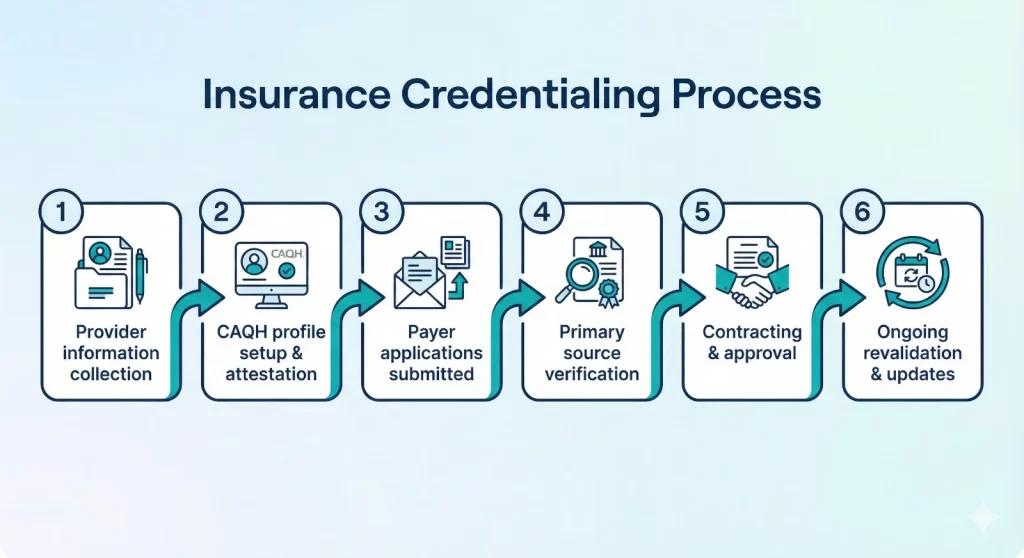 It can be overwhelming to begin, but breaking it down into small steps makes it easier. Begin by gathering the necessary documents, including diplomas and licenses, DEA registration, and proof of malpractice insurance. The accuracy of this information is crucial. Any error can delay everything.
Then, sign up for CAQH ProView, the preferred platform for the majority of payors. Upload your data once, and then allow insurers to access it. This reduces redundancy and saves hours. Apply this to specific payors. For Medicare, you can use PECOS (Provider Enrollment, Chain, Ownership, and Supply) to complete forms for private plans, such as Aetna.
Primary source verification is the next step, in which the payers verify the originals from boards or schools. It can take between 30 and 180 days, so be prepared for new employees. Once you’ve been approved, sign the contracts that outline the terms and rates. Please keep it in force for a period of 2 to 3 years. And update any changes to shifts in address quickly.
Imagine you are on the way to a specialist. Begin early, keep track of deadlines using a spreadsheet and then follow up every week. Tools such as CAQH simplify this process; however, perseverance will pay off.
It can be overwhelming to begin, but breaking it down into small steps makes it easier. Begin by gathering the necessary documents, including diplomas and licenses, DEA registration, and proof of malpractice insurance. The accuracy of this information is crucial. Any error can delay everything.
Then, sign up for CAQH ProView, the preferred platform for the majority of payors. Upload your data once, and then allow insurers to access it. This reduces redundancy and saves hours. Apply this to specific payors. For Medicare, you can use PECOS (Provider Enrollment, Chain, Ownership, and Supply) to complete forms for private plans, such as Aetna.
Primary source verification is the next step, in which the payers verify the originals from boards or schools. It can take between 30 and 180 days, so be prepared for new employees. Once you’ve been approved, sign the contracts that outline the terms and rates. Please keep it in force for a period of 2 to 3 years. And update any changes to shifts in address quickly.
Imagine you are on the way to a specialist. Begin early, keep track of deadlines using a spreadsheet and then follow up every week. Tools such as CAQH simplify this process; however, perseverance will pay off.