
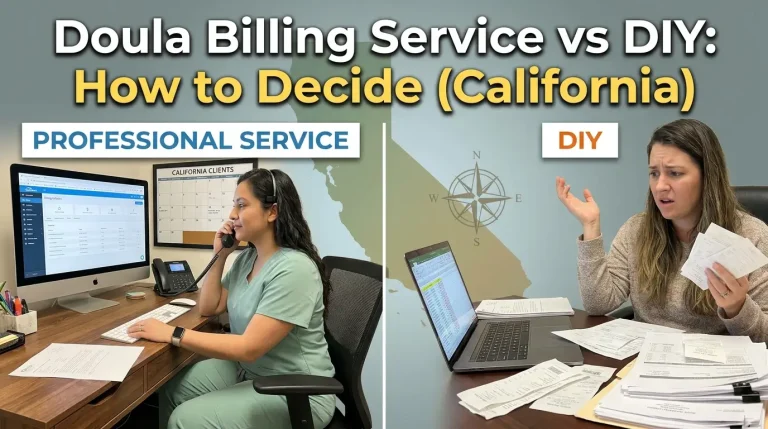
Bill your own claims if you only serve Medi-Cal fee-for-service members, submit fewer than about ten claims a month, and have a system for tracking the six-month filing limit. Hire a doula billing service once you contract with managed care plans.
Who this is for: California doulas enrolled in Medi-Cal, or about to enroll, who are deciding whether to keep billing in-house or pay someone to do it. If you are still working through PAVE, read how long PAVE enrollment actually takes first and come back to this page once you have an approval date.
What doula billing actually involves
People underestimate this work because a doula claim looks simple. One visit, one code, one line. The complexity sits in the rules around that line.
The codes. Medi-Cal lists nine billable codes for doula services. HCPCS codes are Healthcare Common Procedure Coding System codes, a federal code set for services and supplies. CPT codes are Current Procedural Terminology codes, the American Medical Association code set used for procedures.
| Code | Service | Limit |
|---|---|---|
| Z1032 | Extended initial visit, 90 minutes | Must run a full 90 minutes to bill this code |
| Z1034 | Prenatal or postpartum visit | Part of the eight additional visits |
| Z1038 | Additional postpartum visit | Up to nine, second recommendation required |
| T1032 | Extended postpartum support, per 15 minutes | 12 units per visit, 24 units per pregnancy, on separate days |
| 59409 | Support during vaginal delivery | Once per pregnancy |
| 59612 | Support during vaginal delivery after a previous cesarean | Once per pregnancy |
| 59620 | Support during cesarean delivery | Once per pregnancy |
| T1033 | Support during or after miscarriage | Once per pregnancy |
| 59840 | Support during or after abortion | Once per pregnancy |
The modifier. Every doula claim carries modifier XP. A modifier is a two-character suffix that tells the payer something extra about the service. XP means separate practitioner, and on a doula claim it signals that a doula provided the service rather than a licensed clinician. Doulas bill several of the same codes that physicians and midwives bill, at the same rates, so without XP the claim looks like a clinical service and denies.
The diagnosis code. The Medi-Cal provider manual pairs each doula code with specific ICD-10-CM diagnosis codes, and the billing codes page of that manual requires one in both fee-for-service and managed care. Z1032 takes Z32.2, Z32.3, Z39.1 or Z39.2. Z1034 takes Z32.2 or Z32.3. The delivery codes take Z33.1 or Z39.0. T1032 and Z1038 take Z39.0, Z39.1 or Z39.2. Note that DHCS still has an older provider FAQ saying fee-for-service claims need no diagnosis code. The provider manual is the newer document and the one that governs. Send the diagnosis code.
The recommendation. Doula services are a preventive benefit, so they need a written recommendation from a physician or other licensed practitioner. The DHCS Medical Director issued a standing recommendation that covers the initial set of services for any member who is pregnant or was pregnant within the past year. The nine additional postpartum visits are different. They need a second recommendation, and the standing recommendation cannot supply it.
The documentation. You have to record the date, the time and duration, and the nature of what you provided for each visit. DHCS can ask to see it.
The visit math. One visit per day per member. Only one doula bills for a given visit. The labor and delivery codes pay once per pregnancy. Miscarriage support only pays when a licensed provider confirmed the pregnancy first, and abortion support only pays when there is documentation of the abortion service.
None of that is beyond a careful person. It is simply a second job with its own deadlines.
What one pregnancy is worth
You cannot judge a billing fee until you know what you are collecting. These are the Medi-Cal fee-for-service rates DHCS published after the Targeted Rate Increase that took effect on January 1, 2024.
| Code | Service | Rate per visit |
|---|---|---|
| Z1032 | Extended initial visit, 90 minutes | $197.98 |
| Z1034 | Prenatal or postpartum visit, up to 8 | $162.11 |
| Z1038 | Additional postpartum visit, up to 9 | $162.11 |
| T1032 | Extended postpartum visit, up to 2 | $486.36 |
| 59409 | Support during vaginal delivery | $685.07 |
| 59612 | Support during vaginal delivery after a previous cesarean | $768.69 |
| 59620 | Support during cesarean delivery | $795.73 |
| T1033 | Support during or after miscarriage | $250.85 |
| 59840 | Support during or after abortion | $250.85 |
DHCS also publishes the maximum per pregnancy under the initial recommendation. If you provide every covered visit and attend the birth, that comes to $3,152.65 for a vaginal delivery, $3,236.27 for a vaginal delivery after a previous cesarean, and $3,263.31 for a cesarean. A second recommendation for all nine additional postpartum visits adds up to $1,458.99 on top.
Two things follow from that table.
First, a full episode of care is worth roughly three thousand dollars, and the single largest line is the birth. If one delivery claim denies and nobody works it, you lose more than four prenatal visits earned.
Second, managed care is its own number. Plans negotiate their own rates with contracted providers, and those rates have to be no less than the fee-for-service level. So the state table is your floor in managed care, not your answer. Check your contract.
Rates and limits change. Confirm current figures in the Medi-Cal provider manual before you build a budget on them.
The part of DIY that costs real money
The risk in doing your own billing is not that you will code a visit wrong. It is that a claim will sit somewhere while a clock runs out.
The six-month billing limit. Medi-Cal has to receive an original fee-for-service claim within six months following the month of service. The manual gives this example: service on April 15 means the claim must reach Medi-Cal before October 31. After that window, payment drops on a schedule set by state law.
| When Medi-Cal receives the claim | What you get paid |
|---|---|
| Within six months following the month of service | 100 percent of the payable amount |
| Seventh through ninth month | 75 percent |
| Tenth through twelfth month | 50 percent |
| After the twelfth month | Denied |
Approved delay reasons can extend that, but they have their own limits and you have to document them.
The two clocks after a denial. When a claim denies, you get a Remittance Advice Details document, the RAD. A Claims Inquiry Form has to reach Medi-Cal within six months of the RAD date. A formal appeal has to be filed within 90 days of the date on the RAD or the claims inquiry response. Miss those and the money is gone, even when the claim was correct.
This is where self-billing usually fails. Not at submission, at follow-up. Claims go out, some come back denied, and the denials sit in a folder because you are at a birth.
Managed care multiplies the work. Medi-Cal members reach doula services two ways: fee-for-service members use enrolled doulas who bill DHCS directly, and managed care members go through their plan. To be paid for those members, you have to be contracted with the member’s plan or have another arrangement with it. You can contract with several plans. Each one brings its own provider portal, its own claim submission path, its own filing deadline written into the contract, and its own appeals process.
One payer is a task. Five payers is a workflow.
Eligibility. You are expected to verify Medi-Cal eligibility for the month of service. Eligibility moves. A member can shift between fee-for-service and a plan, or between plans, mid-pregnancy. If you bill the wrong entity you do not just get a denial, you burn weeks of your filing window finding out.
What a billing service costs, and where the math turns
Most California billing companies charge a percentage of what they collect for you. Claim N Billing charges 5 to 8 percent of collections with a $200 monthly minimum. Where you land in that range depends on claim volume and payer mix.
The percentage is the easy part. The minimum is what decides this for a solo doula.
Here is the same 6 percent rate across different months, assuming a $200 minimum.
| You collect in a month | 6 percent of that | What you actually pay | Effective rate |
|---|---|---|---|
| $1,000 | $60 | $200 | 20 percent |
| $2,500 | $150 | $200 | 8 percent |
| $3,350 | $201 | $201 | 6 percent |
| $6,000 | $360 | $360 | 6 percent |
| $12,000 | $720 | $720 | 6 percent |
Read that table honestly. Below roughly $3,300 a month in collections, you are paying the minimum and your real rate is higher than the headline number. One full episode of care is about $3,100, so a doula supporting one birth a month sits right at that line.
This is the point most billing companies will not tell you. If you are billing a handful of fee-for-service claims a month, a percentage service with a minimum is not an obvious win on cost alone. It becomes one when volume rises, when managed care contracts enter the picture, or when claims are being lost.
One thing the percentage model does get right: the biller is paid when you are paid. Nobody earns a fee on a claim that sits unworked.
When doing it yourself is the right call
Keep billing in-house if all four of these are true.
You bill fee-for-service only. One payer, one submission path, one set of rules. That is a manageable amount of learning.
Your volume is low and steady. Under about ten claims a month, the work fits into a weekly block. You will not fall behind.
You have a tracking system you actually use. A spreadsheet is enough. It needs a row per claim with date of service, code, modifier, diagnosis code, date submitted, date paid, and the date your filing window closes. If you are not willing to maintain that, you do not have a system.
You enjoy the administrative side, or at least do not resent it. This matters more than people admit. Billing you resent is billing you postpone, and postponed billing is the six-month limit coming for you.
There is no shame in this column. A doula with three fee-for-service clients and a tidy spreadsheet does not need to pay anyone.
When to hand it over
These are the signals that billing has outgrown you. Any one of them is enough.
You have signed, or are signing, managed care contracts. This is the clearest line. Each plan adds a portal, a deadline, and an appeals process. The admin load does not grow in a straight line as you add plans.
You have claims you have not looked at in 60 days. Open a denial that is 60 days old and you may already have spent two thirds of your appeal window.
You have missed a filing deadline, even once. A missed six-month limit is a visible, dated loss. If it happened once during a busy stretch, it will happen again during the next one.
You are turning down clients to protect your admin time. You are now paying for billing. You are paying in refused work, which is the most expensive way to pay for anything.
You have added a second doula or formed a group. Group billing introduces rendering provider setup, per-doula tracking, and the rule that only one doula bills a visit on a given day.
You do not know your denial rate. Not a guess, the number. If you cannot say what percentage of your claims were denied last quarter and why, nobody is managing your revenue.
The option nobody mentions: don’t choose all of it
DIY and full outsourcing are not the only two doors.
Setup and training, then you run it. Someone configures your submission path, builds your claim tracker, walks you through the code and modifier rules, and leaves. You bill, you own it. This suits a doula with low volume who simply wants to stop guessing.
Denials and appeals only. You submit clean claims yourself and send anything that denies to a biller. The work you are worst positioned to do, the follow-up, goes to someone with time for it. The submission work you already do stays with you.
Credentialing and contracting only. Getting contracted with CalOptima, IEHP, L.A. Care, Anthem, Molina, Health Net, Blue Shield of California or Kaiser is a project with a start and an end. You can buy help for the project without buying a monthly service.
Full billing. Submission, follow-up, denials, appeals, posting, and a monthly report. Right once volume or payer count makes the first three options feel like duct tape.
Ask any company you talk to whether they will sell you one piece. If the only answer is the full package, that tells you something about whether they are solving your problem or selling their product.
Seven questions before you sign with anyone
Use these on us too.
- Have you billed Medi-Cal doula claims before, and for how many doulas? Doula codes are local Z codes with a modifier requirement most billers have never touched.
- Who follows up on a denial, and how fast? Ask for the specific interval, not a promise of diligence.
- What is your minimum monthly fee, and at what collection level do I stop paying it? Run that against your own numbers before you sign.
- Do you handle managed care contracting, or only claims? These are separate jobs and separate skills.
- What report do I get each month, and does it show denials by reason? A payment total is not a report.
- What happens to my claims data if I leave? Ask about the exit before you worry about the start.
- Is there a contract term, and what is the notice period? Month to month is a sign of confidence.
How Claim N Billing handles doula billing
CNB started on the other side of this problem. The founders ran a non-emergency medical transportation company, watched billing fail from the inside, brought it in-house, and fixed it. The company that grew out of that now bills for small California practices, and doulas are one of five specialties we work in.
What that means in practice for a doula client:
We submit on your codes and your modifiers, with the diagnosis pairing the Medi-Cal provider manual requires, and we track every claim against its filing window rather than against a vague sense that it went out recently.
We work denials as denials, not as a backlog. CNB runs a 98 percent clean claim rate and a 40 percent reduction in denials for the practices we take on.
We deal with California plans every day, including CalOptima, IEHP, L.A. Care, Molina, Anthem, Health Net, Blue Shield of California and Kaiser. California Medi-Cal managed care is the work, not a sideline.
You talk to the same small team every time. There is no call centre.
Full detail of what is included sits on the doula billing services page, and the pricing model is explained in the medical billing pricing guide.
Work out your own number
If you want a straight answer on whether outsourcing makes sense at your volume, two options.
Run your figures through the claims calculator, or book a free billing audit and we will look at your actual claims, tell you what is sitting unworked, and say plainly if you are better off keeping it in-house.
Call 949-969-4397 or email info@claimnbilling.com.
Common questions
Can I bill Medi-Cal myself as a doula?
Yes. Fee-for-service doula claims are submitted by a doula enrolled in Medi-Cal or by an enrolled doula group, directly to DHCS. You do not need a billing company to be paid.
Do I need billing software or a clearinghouse?
Not for fee-for-service. Medi-Cal accepts electronic claims through the Medi-Cal Provider Portal, which the provider manual calls the most efficient route, and it accepts the paper CMS-1500 form. Managed care plans each set their own submission method, so check each contract.
Can I bill for managed care members without a contract?
No. If the member is in a managed care plan, you have to be contracted with that plan or have another arrangement with it to be reimbursed. You can contract with more than one plan. Timelines vary, and doula managed care contracting takes longer than most people plan for.
Can I bill for services I provided while my PAVE application was pending?
Once your application is approved, you may bill DHCS for fee-for-service members retroactively to the date you submitted the application that was approved. That retroactive window still sits inside the six-month billing limit, so do not let those claims age.
What happens if I miss the six-month filing deadline?
Without an approved delay reason, a claim received in the seventh through ninth month after the month of service pays at 75 percent. Months ten through twelve pay at 50 percent. After the twelfth month, it is denied.
Which codes do I use for which visit?
The full code set with limits is in the Medi-Cal doula billing codes guide. If claims are already coming back denied, the pattern is usually one of five causes, covered in why Medi-Cal doula claims get denied.
Is 5 to 8 percent a normal rate?
It is inside the normal range for small-practice billing in California. Judge a quote on the minimum fee and the scope of work, not the percentage alone. A low percentage that excludes denials and appeals is not a low price.