
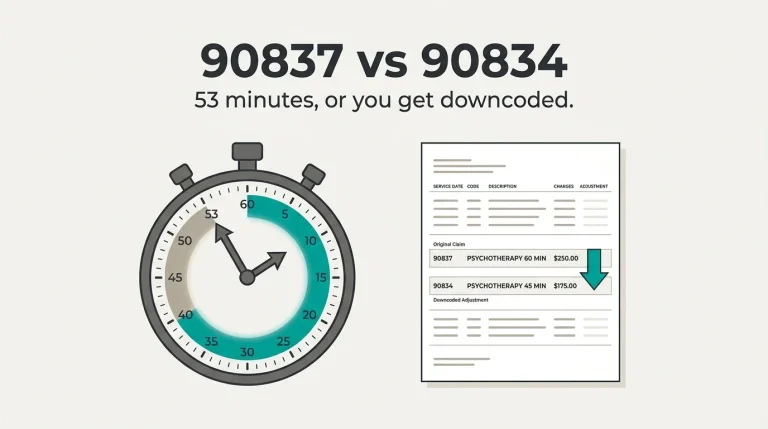
CPT code 90834 covers 38 to 52 minutes of face-to-face psychotherapy. CPT 90837 covers 53 minutes or more. The only difference between them is documented time. Payers downcode 90837 to 90834 when the note does not prove 53 minutes.
If you are a California therapist, psychologist, or psychiatric prescriber billing commercial plans, Medicare, or Medi-Cal, this one is for you.
The two codes differ on time, and nothing else
CPT stands for Current Procedural Terminology, the code set the American Medical Association maintains to describe services on a claim. The individual psychotherapy codes are a time ladder.
| Code | Documented psychotherapy time | Label people use |
|---|---|---|
| 90832 | 16 to 37 minutes | 30-minute session |
| 90834 | 38 to 52 minutes | 45-minute session |
| 90837 | 53 minutes or more | 60-minute session |
Medicare’s billing and coding guidance tells you to choose the code closest to the actual time, using those exact ranges, and not to report psychotherapy at all under 16 minutes. Noridian, the Medicare Administrative Contractor for California, publishes the same three ranges on its mental health page for Jurisdiction E.
Two things follow from that. A 52-minute session is 90834, not 90837. And the modality does not decide the code. EMDR, CBT, DBT, and grief work all sit on the same ladder. Only the clock moves you up it.
What actually counts toward the clock
Only face-to-face psychotherapy time with the patient present counts. Scheduling, intake paperwork, note writing, chart review, and phone calls after the session do not.
If you deliver an evaluation and management (E/M) service in the same visit, which is common for prescribers, the E/M time is separate. Medicare expects the note to show psychotherapy start and stop times or total psychotherapy time, and to keep the E/M work separately identifiable in the record.
So the session that felt like an hour is often 47 minutes of therapy plus 13 minutes of everything else. That is a 90834.
What downcoding looks like on your remittance
Downcoding is the payer paying you for a lesser service than the one you billed. In behavioral health it shows up three ways.
The claim pays, but at the 90834 allowed amount, with a remark code on the line explaining the adjustment. The claim sits unpaid while the payer requests records first. Or the claim denies outright for documentation that does not support the level of service.
Read the remark codes on the remittance advice before you do anything else. Payers use different code combinations for the same action, so the remark text on your specific remit is what tells you whether you are looking at a coding adjustment, a records request, or a medical necessity denial. Each one gets a different response.
Why 90837 draws attention in California right now
This is not a theoretical risk in this state.
Noridian’s Jurisdiction E Part B medical review department has been running a Targeted Probe and Educate (TPE) review of CPT 90837 specifically. In the results Noridian published for the April 1 to June 30, 2025 quarter, the top denial reasons were failure to return records, documentation that does not support the modifiers billed, and documentation that does not support the level of service billed. Noridian’s guidance on that same page is blunt: if time spent is not documented, no payment will be made.
TPE is a pre-payment review process. CMS describes it as up to three rounds of 20 to 40 claims each, with one-on-one education after each round. Providers who correct the errors exit the process. Providers whose error rates stay high after three rounds get referred back to CMS, which can mean 100 percent prepayment review, extrapolated overpayment demands, or a referral to a Recovery Auditor.
The commercial side has its own history. In 2023, APA Services reported that Optum, which manages behavioral health for UnitedHealthcare, sent psychologists letters saying claims would not be paid until extensive records were faxed or mailed for review. APA Services and the American Psychiatric Association pushed back jointly, and Optum paused those prepayment reviews of psychologists.
The pattern is consistent. The higher-paying psychotherapy code gets reviewed, and the review is a documentation test.
What Medi-Cal does differently
Two California-specific rules are worth knowing, because they do not match commercial plan behaviour.
In Medi-Cal fee-for-service, the provider manual states that authorization is not required for outpatient psychiatric services. Providers coming from states with routine authorization requirements for extended sessions often over-prepare here.
For county specialty mental health services, the Department of Health Care Services (DHCS) billing manual sets a claiming ceiling. The maximum that can be claimed using 90837 is 60 minutes of psychotherapy. If a beneficiary is seen for 75 minutes, DHCS instructs the provider to bill one unit of 90837 plus one unit of G2212, with the primary code and the add-on on the same claim. A service line billed with the add-on and no primary code on the claim denies.
Medi-Cal managed care plans, including CalOptima, IEHP, L.A. Care, Health Net, and Molina, set their own utilization rules on top of that. Verify the extended session policy with the plan before you build a caseload around 60-minute sessions.
The note that survives a review
The reviewer is not in the room. The note is the entire case. Every 90837 note should carry all of the following.
- Exact start and stop times, or total psychotherapy time. Time is not supporting detail on a time-based code. It is the claim.
- Time that reflects face-to-face psychotherapy only, with E/M time stated separately if an E/M service was also delivered.
- The ICD-10 diagnosis being treated, connected to the work you did that day.
- The specific interventions used, not a modality label alone.
- The patient’s response and progress against the treatment plan.
- A clinical reason the session needed the extra time, written for that date of service.
- A legible signature and credential, with patient identifiers and the date on every page.
One point most practices miss. Under 45 CFR 164.501, the federal definition of protected “psychotherapy notes” specifically excludes counseling session start and stop times, modalities and frequency of treatment, test results, diagnosis, functional status, treatment plan, symptoms, prognosis, and progress. Noridian’s own education on the 90837 review states that if those elements sit inside a document you consider psychotherapy notes, you are still responsible for extracting the information that supports the claim. You cannot decline a records request on the grounds that the whole note is protected. Confirm how this applies to your record system with your compliance counsel.
A workable structure for the time line in your template:
Psychotherapy start [00:00], stop [00:00], total psychotherapy time [00] minutes. E/M time, if applicable, documented separately. Extended session clinically indicated because [specific reason tied to this date and this presentation].
Should you just bill 90834 to stay safe?
No. Billing 90834 for a documented 58-minute session is inaccurate coding in the other direction, and it takes money out of the practice every week for a risk you have not actually removed.
Bill what the clock and the note support. If your caseload genuinely runs long, your code distribution will lean toward 90837 and your documentation has to carry that. If every single claim you submit is 90837 and every note reads identically, that uniformity is what draws data-driven review, not the code itself.
The allowed amount for 90837 is higher than 90834 under the Medicare Physician Fee Schedule and under most commercial contracts. The exact gap depends on your locality and your contracted rate, so look both codes up for your area in the CMS Physician Fee Schedule Look-Up Tool and compare that against your contracted fee schedule before you decide anything about session length.
What to do when a claim comes back downcoded
- Pull the remittance and read the remark codes on the line, not just the paid amount.
- Pull the note and check it against the list above. If the time is missing or the session was under 53 minutes, the payer is right, and the fix is documentation going forward.
- If the documentation supports 53 minutes or more, decide between a corrected claim and an appeal. That choice depends on whether the payer adjusted the code or denied the service.
- Send the note with the time line and the clinical rationale flagged. Do not send the entire chart.
- Check your appeal window. Filing deadlines for appeals vary by payer and by contract, and missing one ends the claim regardless of merit. Confirm yours in the provider agreement rather than assuming.
- Track downcodes by payer for 90 days. One is noise. A pattern from one plan is a policy you need to know about.
If you are already seeing a pattern, our denial management and appeals team works these by payer, and our guide on preparing your practice for a payer audit covers what to have ready before a records request lands.
Frequently asked questions
Neither, exactly. The descriptor says 60 minutes, but the billing threshold is 53 minutes of face-to-face psychotherapy. A session documented at 53 minutes qualifies. A session documented at 52 minutes is 90834.
You can bill it for every session that documents 53 minutes or more and shows why the time was clinically necessary. What creates exposure is uniform documentation, not the code. Notes that vary because sessions actually vary are the defence.
There is no higher standalone individual psychotherapy code, and the prolonged service code set changed in 2023, so the correct handling now depends on the payer. For county specialty mental health claiming, DHCS instructs 90837 plus G2212 on the same claim. For Medicare and commercial plans, confirm the current rule before you add anything.
No. The code still follows documented face-to-face therapy time. What changes is the place of service and the modifier, and those rules differ by payer.
Some payers apply automated code-edit logic before any human review. That is why the remittance remark codes matter, and why the appeal usually starts by putting the note in front of a reviewer for the first time.
Get the pattern fixed, not just the claim
Claim N Billing is a family-run billing company in Irvine, California. We work behavioral health claims across Kaiser, Anthem Blue Cross, Blue Shield of California, Optum, Health Net, Molina, CalOptima, IEHP, and L.A. Care, and we hold a 98 percent clean claim rate across the practices we bill for.
If 90837 claims are coming back short and you cannot tell whether it is your documentation or the payer’s edit logic, we will look at it. Request a free billing audit, call 949-969-4397, or book a meeting.
For more on how we handle behavioral health revenue cycle work, see our mental health billing services page and our answers to common billing questions from therapists and psychiatrists.