
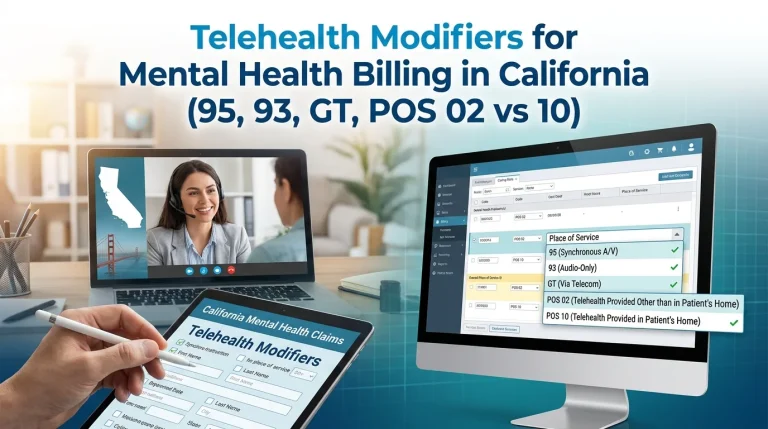
Quick answer: On a California telehealth therapy claim, the place of service code shows where the patient was: POS 10 for home, POS 02 for anywhere else. The modifier shows how you connected: 95 for video, 93 for audio-only. Original Medicare doesn’t require 95, and county Medi-Cal behavioral health programs use GT and SC instead.
This guide is for California therapists, psychologists, LCSWs (licensed clinical social workers), LMFTs (licensed marriage and family therapists), and psychiatric prescribers who bill telehealth sessions to Medicare, Medi-Cal, or commercial insurance.
Key points
- The POS code and the modifier answer two different questions. Payers check each one against the other and against your note.
- Original Medicare pays POS 10 claims at the non-facility rate and POS 02 claims at the lower facility rate.
- Medi-Cal fee-for-service and Medi-Cal managed care plans use 95 for video and 93 for audio-only.
- Medicare limits modifier GT to one institutional use, but county Specialty Mental Health Services still require it for video.
- Blue Shield of California denies claims that carry modifier 93, 95, or GQ without POS 02 or 10, effective January 1, 2025.
What do telehealth modifiers and POS codes tell the payer?
A place of service (POS) code is the two-digit code in box 24B of the CMS-1500, the standard claim form for professional services. It tells the payer where the service took place. CMS maintains two POS codes for telehealth: 02 and 10.
A modifier is a two-character code attached to a CPT (Current Procedural Terminology) code, such as 90834 or 90837 for individual psychotherapy. A telehealth modifier tells the payer which technology you used: live video, audio-only, or store-and-forward. When the POS code, the modifier, and your note disagree, the claim is exposed to denial or recoupment.
If you’re newer to therapy billing, start with our answers to the 7 mental health billing questions therapists and psychiatrists ask.
POS 02 vs POS 10: which one do you use?
Use POS 10 when the patient was in their home during the session. Use POS 02 when the patient was anywhere else, such as a clinic, school, or other facility. Your own location doesn’t change the code. If you work from your office and your client joins from their apartment, the claim gets POS 10.
CMS defines home for POS 10 as a location other than a hospital or other facility where the patient receives care in a private residence. Noridian, the Medicare contractor that processes Part B claims for California, says POS 10 still applies when the patient uses temporary lodging such as a hotel, or steps a short distance from home for privacy, such as into their car.
That matters in therapy. A client who takes a session from a parked car for privacy still gets POS 10 on a Medicare claim.
Does POS 02 pay less than POS 10?
With original Medicare, yes. Since January 1, 2024, CMS pays telehealth to patients at home at the non-facility rate, and POS 02 claims pay at the facility rate. The gap depends on the code and your locality, so check the Medicare Physician Fee Schedule lookup for your codes.
Medi-Cal is different. The Department of Health Care Services (DHCS) states that fee-for-service Medi-Cal and Medi-Cal managed care plans pay the same amount for a telehealth service as for the same service in person.
For commercial coverage, California’s AB 744 added Health and Safety Code section 1374.14 and Insurance Code section 10123.855. Contracts issued, amended, or renewed on or after January 1, 2021 must reimburse telehealth on the same basis and to the same extent as the equivalent in-person service. The rate itself stays negotiable. In January 2022, Anthem Blue Cross confirmed that California professional claims billed with POS 02 or 10 are eligible for office-rate reimbursement.
The parity law applies to state-regulated coverage. If a commercial payer pays a telehealth claim below your in-person rate, confirm the plan is state-regulated and talk with your compliance counsel before you dispute it on parity grounds.
What do modifiers 95, 93, GT, SC, GQ, and FQ mean?
Telehealth modifiers describe the technology behind the session. Here’s what each one means and where it applies on California mental health claims.
| Modifier | What it means | Where it applies for California mental health claims |
|---|---|---|
| 95 | Synchronous telemedicine service rendered via a real-time interactive audio and video telecommunications system | Medi-Cal fee-for-service and managed care video sessions. Commercial plans recognize it, with requirements that vary by policy. Medicare Part B doesn’t require it on standard telehealth claims. |
| 93 | Synchronous telemedicine service rendered via telephone or other real-time interactive audio-only telecommunications system | Audio-only sessions for Medicare, Medi-Cal, and UnitedHealthcare commercial plans (Appendix T codes only). |
| GT | Telehealth service via interactive audio and video telecommunication systems | County Specialty Mental Health Services, Drug Medi-Cal, and DMC-ODS video sessions. In Medicare, only critical access hospital Method II institutional claims. |
| SC | Assigned by DHCS to audio-only services in county behavioral health programs | County Specialty Mental Health Services, Drug Medi-Cal, and DMC-ODS phone sessions. |
| GQ | Telehealth service rendered via an asynchronous (store-and-forward) telecommunications system | Not used for live therapy sessions. Medi-Cal store-and-forward services. In Medicare, only the Alaska and Hawaii federal demonstration. |
| FQ | The service was furnished using audio-only communication technology | Medicare claims from rural health clinics (RHCs) and federally qualified health centers (FQHCs) only. |
Is modifier GT still used in California?
Yes, but only in specific systems. Medicare allows GT only on institutional claims from critical access hospitals billing under Method II, so a private practice billing Medicare Part B shouldn’t use it. County Medi-Cal behavioral health is the exception that catches practices.
Under DHCS Behavioral Health Information Notice (BHIN) 23-018, telehealth modifiers are mandatory on Specialty Mental Health Services (SMHS), Drug Medi-Cal (DMC), and Drug Medi-Cal Organized Delivery System (DMC-ODS) claims. Those programs use GT for video, SC for audio-only, and GQ for store-and-forward e-consults in DMC-ODS. For outpatient services on or after July 1, 2023, a claim with a telehealth modifier must also carry POS 02 or 10, unless the service is Mobile Crisis Services.
The Medi-Cal medical side works differently. The Medi-Cal Provider Manual assigns 95 to video, 93 to audio-only, and GQ to store-and-forward, and DHCS applies those modifiers to both fee-for-service and managed care. If your practice holds a county contract and managed care plan contracts, the same video session can need GT on one claim and 95 on the other. Build that split into your billing rules by payer, not by clinician.
Telehealth modifier rules by California payer
This table reflects public payer and government policies we reviewed in September 2026. Your contract can override a general policy, and payers revise these documents, so confirm against the current version before you change your billing setup.
| Payer | Video | Audio-only | POS | What to watch | Source reviewed |
|---|---|---|---|---|---|
| Original Medicare (Noridian JE Part B) | No modifier required on standard telehealth claims | 93 | 02 or 10 | POS 10 pays the non-facility rate. POS 02 pays the facility rate. FQ is for RHCs and FQHCs only. | Noridian JE Part B Telehealth page (updated April 2026); CMS Telehealth FAQ (updated February 2026) |
| Medi-Cal fee-for-service and Medi-Cal managed care plans (for example CalOptima, IEHP, L.A. Care) | 95 | 93 | Most applicable POS, including 02 or 10 | Paid at the in-person amount. Document telehealth consent, and separately document consent to audio-only. Check your plan’s provider manual for plan-specific claim edits. | Medi-Cal Provider Manual, Telehealth Modalities (updated May 2026); DHCS Telehealth Modifier Reference Sheet |
| County Specialty Mental Health Services, DMC, DMC-ODS | GT | SC | 02 or 10 for outpatient services (Mobile Crisis Services excepted) | Different modifiers from the Medi-Cal medical side. Also check your county’s current billing manual. | DHCS BHIN 23-018 |
| Blue Shield of California | 95 [VERIFY: whether required on your contract] | 93 | Must be 02 or 10 when 93, 95, or GQ is billed | Claims that pair these modifiers with any other POS are denied, effective January 1, 2025. | Blue Shield of California provider news, March 14, 2025 |
| Anthem Blue Cross (commercial) | [VERIFY] | [VERIFY] | 02 or 10 | Anthem confirmed California professional claims with POS 02 or 10 are eligible for office-rate reimbursement. Current modifier rule not confirmed. | Anthem Blue Cross Provider News, January 2022 |
| UnitedHealthcare (commercial and Individual Exchange) | Not required; 95 and GT accepted as informational | 93, only on CPT Appendix T codes | 02 or 10 | Audio-only codes outside Appendix T aren’t eligible for reimbursement. | UnitedHealthcare policy 2026R0046A (January 2026) |
| Optum Behavioral Health (commercial) | Optional per Optum guide | 93 or FQ listed | 02 or 10 mandatory | [VERIFY: the guide reviewed carries a 2023 date. Confirm the current version on Provider Express.] | Optum post-PHE behavioral health billing guide (2023) |
| Cigna | [VERIFY] | [VERIFY] | [VERIFY] | Cigna’s medical Virtual Care Reimbursement Policy doesn’t apply to Evernorth Behavioral Health plans. Confirm behavioral health telehealth rules with Evernorth. | Cigna for HCP, Virtual Care resource page |
| Aetna, Kaiser Permanente, Health Net (commercial), Molina, Humana, Oscar | [VERIFY] | [VERIFY] | [VERIFY] | [VERIFY: no current public policy confirmed. Check the payer portal or provider manual, or get the rule from your provider representative in writing.] | [VERIFY] |
Why do telehealth therapy claims get denied?
Telehealth modifier denials come from mismatches between the claim, the payer’s rules, and your note. These five are written into current published policies.
1. A telehealth modifier paired with an office POS code
During 2023, Medicare had practices bill telehealth with the POS code they would have used in person, plus modifier 95. That instruction ended December 31, 2023. If your practice management system was set up during that period, check that it no longer defaults telehealth appointments to POS 11 (office). Blue Shield of California denies claims that pair 93, 95, or GQ with anything other than POS 02 or 10, effective January 1, 2025.
2. Modifier 93 on a code the payer doesn’t cover for audio-only
UnitedHealthcare’s commercial policy pays audio-only telehealth only for codes listed in Appendix T of the CPT code set, billed with modifier 93 and POS 02 or 10. A 93 on a code outside Appendix T isn’t eligible for reimbursement under that policy.
3. A video modifier on a phone session
Modifier 95 describes real-time audio and video. If the session ran by phone, 95 misstates the service. Medicare and Medi-Cal both use 93 for audio-only, and Medi-Cal requires documented member consent to audio-only before you deliver it.
4. A POS code that doesn’t match the note
If your note says the client joined from a school counseling office and the claim says POS 10, the claim and the record disagree. On Medicare, that also bills the non-facility rate for a service that belongs at the facility rate.
5. County and plan modifiers crossed
A 95 on a county SMHS claim, or a GT on a managed care plan claim, breaks that system’s billing rules. Set modifier logic by payer in your practice management system.
One more cause sits outside coding. A telehealth claim won’t pay if the rendering clinician isn’t credentialed with the plan, and Medi-Cal requires telehealth clinicians to be licensed in California and enrolled, or affiliated with an enrolled provider group located in California or a border community. Our guide to insurance credentialing for mental health providers covers that side.
Which denial codes show up on the remittance?
Payers explain adjustments with claim adjustment reason codes (CARCs), a standard code set used on electronic remittance advice. Three fit telehealth mismatches:
- CARC 4: the procedure code is inconsistent with the modifier used.
- CARC 5: the procedure code or type of bill is inconsistent with the place of service.
- CARC 58: the payer deemed the treatment rendered in an inappropriate or invalid place of service.
Payers pick the code, so one error can return under different CARCs. Read the remittance advice remark code (RARC) alongside the CARC before you correct and resubmit.
[CNB DATA BLOCK: Replace with one real, anonymized pattern from Claim N Billing’s own California telehealth claim work, for example which mismatch you correct most and which payer it involves. Use real counts only. No client names, no results, no PHI. Delete this block if verified data isn’t available. Do not publish with this placeholder visible.]
What should a telehealth therapy note include?
Medi-Cal expects telehealth documentation to match what you’d record for the same service in person. UnitedHealthcare asks for the same, plus a statement that the visit took place through audio-video. Medi-Cal also requires you to document the member’s verbal or written consent to telehealth before the first telehealth service, and to document consent before the first audio-only service. Telehealth providers must also offer in-person services or keep a documented process for linking members to in-person care.
Beyond what those policies spell out, Claim N Billing (CNB) recommends four items in every telehealth note, because each one supports a specific part of the claim:
- Where the patient was when the session started. This supports the POS code.
- Whether the session ran on video or audio-only, and whether that changed. This supports the modifier.
- Where the telehealth consent, and the audio-only consent if used, is filed.
- Start and stop times for any time-based code you bill.
Medicare telehealth for therapists: what’s in effect for 2026 and 2027
The Consolidated Appropriations Act, 2026, signed February 3, 2026, extended Medicare’s telehealth flexibilities through December 31, 2027. Four points matter for mental health providers.
- Home and location: The Consolidated Appropriations Act, 2021 permanently removed geographic and place-of-service restrictions for behavioral health telehealth, so rural and urban Medicare patients can receive therapy at home.
- In-person visit requirement: CMS says the requirement for an in-person visit within 6 months before the first mental health telehealth service takes effect after December 31, 2027. Patients who begin mental health telehealth at home on or before that date count as established and will need at least one in-person visit every 12 months after it, with limited exceptions.
- Audio-only: Patients can receive audio-only telehealth at home through December 31, 2027. From January 1, 2028, audio-only behavioral health at home requires that you’re capable of video and the patient can’t use or doesn’t consent to video. Noridian directs you to bill modifier 93 when the patient requests audio-only or doesn’t consent to video.
- Who can bill: Noridian lists clinical psychologists, clinical social workers, marriage and family therapists, and mental health counselors as eligible telehealth practitioners. MFTs and mental health counselors were added for 2024.
For the broader Medicare picture, see what the 2026 Medicare changes mean for your California practice.
Frequently asked questions
Does Medicare require modifier 95 on telehealth therapy claims?
Not on standard professional telehealth claims. Noridian states that 95 applies when the clinician is in a hospital and the patient is at home, or to outpatient therapy from physical, occupational, or speech-language therapists, and isn’t required on other telehealth visits. Report POS 02 or 10, and add 93 for audio-only.
Can I bill POS 11 with modifier 95 for a telehealth session?
Not on Medicare, Blue Shield of California, or county SMHS claims. Medicare ended that method after 2023, Blue Shield denies the combination, and BHIN 23-018 requires POS 02 or 10 with a telehealth modifier on outpatient claims. For other payers, check the current written policy first.
Do I use a different CPT code for telehealth therapy?
Not for Medi-Cal or UnitedHealthcare commercial plans. Medi-Cal has you bill the service’s CPT or HCPCS (Healthcare Common Procedure Coding System) code with the telehealth modifier, and UnitedHealthcare pays codes on its telehealth eligible list with POS 02 or 10. A code has to be on the payer’s list to pay as telehealth.
Want a second look at your telehealth claims?
CNB started when the owners of a non-emergency medical transportation company hit billing problems of their own, took billing in-house, and fixed it. Today we’re a small, family-owned team in Irvine that bills for California mental health providers across Medi-Cal managed care and commercial plans.
If you’re seeing telehealth denials, or you’re not sure your POS and modifier setup matches each payer, start with a free billing audit. You can also book a call, phone 949-969-4397, or read more about our mental health billing services.