
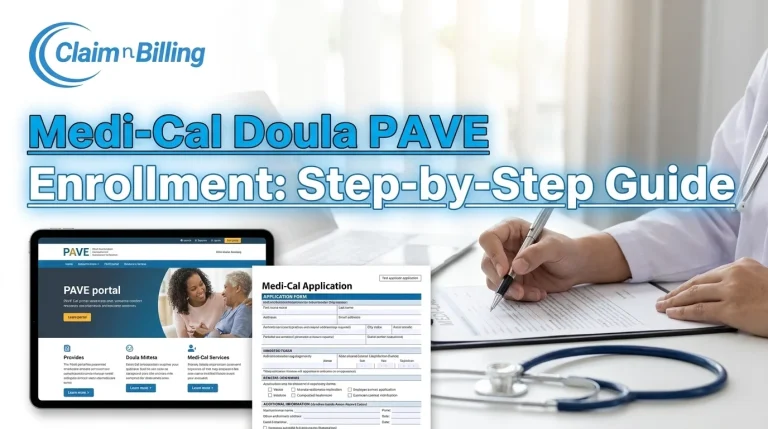
You enroll as a Medi-Cal doula provider by submitting an electronic application through PAVE, the state’s provider enrollment portal. You need an NPI, a driver’s license or state ID, proof of adult and infant CPR certification, HIPAA training, business formation documents, and evidence you meet either the training or the experience pathway.
If you are a California doula planning to bill Medi-Cal, this is the walkthrough. It covers what to gather before you log in, what each application type means, and where applications get sent back.
DHCS has enrolled 1,718 individual doula providers as of August 14, 2026. The benefit has been live since January 2023, so the process is settled. It is just poorly documented in one place.
What PAVE is, and what enrollment does not get you
PAVE stands for Provider Application and Validation for Enrollment. It is the web portal run by the DHCS Provider Enrollment Division, and it is where you submit applications, report changes to an existing enrollment, and respond to state requests for revalidation.
Here is the part that costs doulas months. DHCS is explicit that enrollment in PAVE, managed care credentialing, and managed care plan contracting are three separate and distinct processes, each with its own requirements.
PAVE approval makes you a Medi-Cal fee-for-service provider. It does not put you in any health plan’s network. Most Medi-Cal members are enrolled in a managed care plan such as CalOptima, L.A. Care, IEHP, Molina or Health Net, and DHCS states that plans are not required to contract with every doula enrolled through PAVE.
Finish PAVE first. Then start contracting. Do not wait for one to finish before beginning the other where the plan allows parallel applications.
Gather these documents before you open PAVE
DHCS publishes a doula enrollment checklist. These items are mandatory for every doula applicant.
| Document | Notes |
|---|---|
| Driver’s license or state-issued ID | Must be issued in one of the 50 states or DC |
| Business formation document | Sole proprietorship, corporation, LLC or partnership |
| National Provider Identifier (NPI) | Every doula must have one. Free through NPPES |
| HIPAA training certificate or attestation | PAVE includes a checkbox attestation option |
| CPR certificate or card | Adult and infant, from American Red Cross or American Heart Association, with the approved stamp |
| Training or experience pathway evidence | See the two pathways below |
| Federal Employer Identification Number verification | IRS-generated Letter 147-C, Form 941, Form 8109-C, or the official SS-4 confirmation |
| Local business license, tax certificate or permit | For every city and county where you conduct business |
Two details that get applications returned.
Your NPI type has to match your business structure. Type 1 NPIs are for individuals and sole proprietors. If you formed an LLC or a corporation, DHCS requires you to obtain and use a Type 2 NPI for that entity, even if you are the only owner.
Names and addresses have to match across documents. The legal name on your application must match the name on the IRS document. The name and business address on your application must match the business name and address on every local license and permit.
When you apply for your NPI through NPPES, the doula taxonomy code is 374J00000X. It sits under the Nursing Service Related Providers grouping in the national code set, which confuses people, but you do not need a nursing license to use it.
Choosing your qualification pathway
Every doula must be at least 18 at the time the application is submitted, hold current adult and infant CPR certification, and attest to completing basic HIPAA training. On top of that, you qualify through one of two pathways.
Training pathway. You need a certificate of completion showing a minimum of 16 total hours covering lactation support, childbirth education, foundations on anatomy of pregnancy and childbirth, nonmedical comfort measures and prenatal and labor support techniques, and developing a community resource list. If your certificate does not show the hours and topics, upload a course syllabus and complete the attestation inside the application, naming the training organization, the total hours and the completion date. You also attest that you have supported at least three births as a birth doula.
Experience pathway. You attest to at least five years of active doula experience, paid or volunteer, occurring within the last seven years from your application date. You then upload three written testimonial or recommendation letters.
Pick the pathway your documentation actually supports. Applicants who have both a certificate and years of experience should use the training pathway, because a certificate is a single clean document and three letters are three chances for a formatting problem.
The testimonial letter rules that trip people up
DHCS publishes templates for the experience pathway, and the requirements are specific:
- Letters may come from a physician, licensed behavioral health provider, nurse practitioner, nurse midwife, licensed midwife, enrolled doula, or community-based organization
- At least one letter must be from a licensed provider, a community-based organization, or an enrolled doula
- All letters must be written within the last seven years
- Letters from licensed providers or community-based organizations must be on letterhead
- Every letter needs the signature and printed name of the signer
- Letters from licensed providers must include the license number and state of licensure
- Each letter must name the doula and reference their skills and experience in prenatal, labor and postpartum care
Use the DHCS templates rather than writing your own. The template language may only be modified in the blank fields.
Business licensing, FBNS and workers’ compensation
These come from city, county and state rules, not from DHCS, and they are where solo doulas lose the most time.
Business license. DHCS notes that most cities require a business license even for a one-person, home-based business. It may be called a business tax certificate or business registration certificate depending on the city. If you are outside an incorporated city, check your county.
Fictitious Business Name Statement. State law requires an FBNS, and you file it through your county. You need one if you are a sole proprietor using a business name that does not include your last name, an LLC or corporation using a name that does not exactly match your Articles filed with the Secretary of State, or a partnership using a name that does not include every partner’s last name.
Workers’ compensation. Required only if California law requires it for your business. If it does not apply to you, you do not need to obtain coverage just to enroll.
Which application type to submit
DHCS allows doulas to enroll as individuals, group providers, rendering providers, or ordering/referring/prescribing providers.
| If you are | Submit |
|---|---|
| A solo doula billing under your own NPI | Individual billing provider application |
| Two or more doulas billing under one group NPI at one business location | Group provider application, plus a rendering application for each doula |
| A doula working under someone else’s group | Rendering provider application |
| Already enrolled and joining a group | Rendering-S application |
If you enroll as a group, you do not separately enroll as an individual, but each doula rendering services for the group needs their own application.
The step-by-step in PAVE
Step 1. Get your NPI first. PAVE will not let you proceed without one. Apply free at the NPPES site. Allow time for it to issue before you start.
Step 2. Create your PAVE user account. Go to pave.dhcs.ca.gov and sign up. This creates the login, not the application.
Step 3. Build your PAVE profile. The profile holds your identity and business information and feeds into every application you submit.
Step 4. Answer the questionnaire to open the right application. PAVE uses a short set of questions to route you to the individual, group, rendering or ORP application. Answer these carefully. Choosing the wrong type means starting over.
Step 5. Enter your business address. Doulas are exempted from the standard place of business requirements. You may report an “administrative location,” defined by DHCS as the physical location associated with your operations, including where you are dispatched or based. It can be the same as your mailing address. It cannot be a PO box, and you are not required to provide services there.
Read the next sentence twice. That address appears in provider directories and on the California Health and Human Services Open Data Portal. If you work from home, decide whether you want your home address public before you type it.
Step 6. Complete the attestations. HIPAA training, and either the three-births attestation or the five-years-experience attestation.
Step 7. Upload your documents. DHCS asks that attachments be legible. PDF and JPEG are accepted. Scan, do not photograph at an angle.
Step 8. Electronically sign and submit. Only a person with authority to legally bind the applicant may sign.
Step 9. Watch PAVE for messages. The portal is how the state contacts you about deficiencies. Nobody will call. An unanswered request stalls the application indefinitely.
How long does PAVE approval take
DHCS is required to take action on a submitted electronic application within 180 days of receipt, under California Code of Regulations, Title 22, Section 51000.50.
Read “take action” precisely. Action includes requesting more information from you, not only approving or denying. A request for a missing document restarts your practical timeline even though the state has met its obligation.
DHCS does not publish an average processing time for doula applications. Anyone quoting you a specific number of weeks is guessing. What you control is whether your first submission is complete, because a clean file avoids the deficiency loop entirely.
[VERIFY: whether the Medi-Cal application fee under 42 CFR 455.460 applies to doula applicants. The DHCS doula enrollment checklist does not list an application fee.]
Where doula applications get returned
Based on the published requirements, the failure points are predictable:
- Name mismatch between the application, the IRS document and the business license
- Type 1 NPI used when the doula has formed an LLC, where a Type 2 is required
- CPR certification that covers adult only, or lacks the ARC or AHA approved stamp
- Training certificate that does not state hours or topics, submitted without a syllabus and attestation
- Testimonial letters missing letterhead, license numbers or signatures
- PO box entered as the administrative location
- Messages sitting unread in PAVE
Claim N Billing runs a 98% clean claim rate for the practices we bill. The same principle applies upstream: the cheapest fix is the one made before submission.
After PAVE, you still have work to do
Once you are enrolled, you can bill Medi-Cal fee-for-service directly. To serve members in a managed care plan, you need to complete that plan’s credentialing and sign a Network Provider Agreement with it. You can contract with multiple plans, and which ones make sense depends on the counties you serve.
CNB handles enrollment and contracting through our provider credentialing services. For the contracting side, read our complete guide to insurance credentialing for doulas and the Kaiser doula contracting update. Once you are enrolled and ready to bill, see our doula billing services.
Get help with your enrollment
If your PAVE application has stalled, or you would rather not assemble the file yourself, we will handle it. Book a free billing audit, call 949-969-4397, or email info@claimnbilling.com.